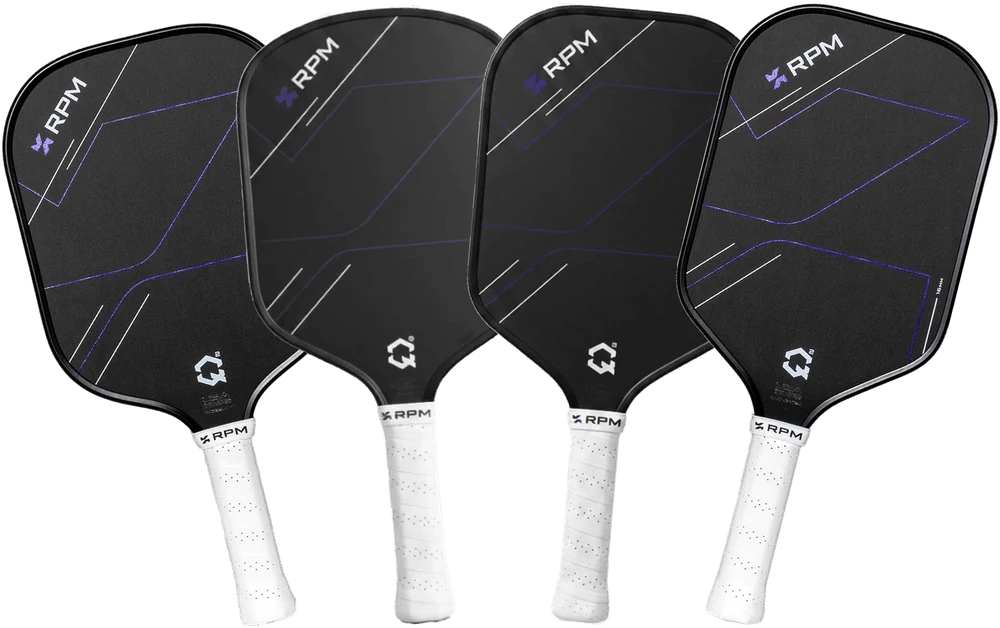
There are three paddle shapes worth knowing: wide body, hybrid and elongated. The flat top hybrid is a version of the hybrid, and right now it's the shape everybody wants.
My bias, up front: I mostly play elongated. A lot of the time that's only because the paddle I want doesn't come in a flat top hybrid. If it did, I'd switch for most of them.
Every shape gets the same 24 inches
USA Pickleball's rulebook caps a paddle at 17 inches long, and length plus width can't go over 24 inches, edge guard and butt cap included. (There's no limit on thickness.) So a paddle that goes all the way to 17 inches can only be 7 inches wide. Nearly every paddle on the shelf goes right up to that 24, so a shape is really a choice about where to spend it. Add length and you give up width. Add width and you give up length.
Here are the median dimensions of about 490 paddles from John Kew Pickleball's lab database, grouped by shape:
| Shape | Length | Width | Handle |
|---|---|---|---|
| Wide body | 15.9 in | 8.0 in | 5.4 in |
| Hybrid | 16.2 in | 7.7 in | 5.5 in |
| Elongated | 16.5 in | 7.5 in | 5.5 in |
Half an inch of length between wide body and elongated. That doesn't sound like much until you see what it does to the numbers.
What shape actually changes
Two numbers do most of the work, the same two from the weight guide.
Swingweight is how heavy the paddle feels when you swing it. A longer paddle puts more of its mass farther from your hand, so swingweight goes up even when the scale says the same thing. More swingweight means more power and slower hands.
Twistweight is how much the face resists twisting when you miss the center. A wider paddle puts mass out on the sides, so twistweight goes up. More twistweight means a steadier face and a sweet spot that feels bigger.
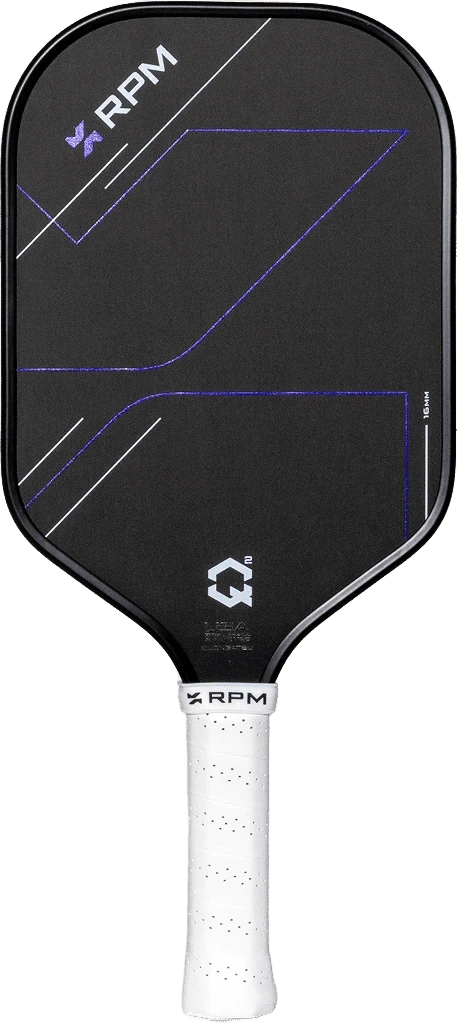
The cleanest way to see it is one paddle sold in every shape. Same brand, same core, same face, only the outline changes. RPM's Q2 16mm comes in all four, and Matt's Pickleball measured each one:
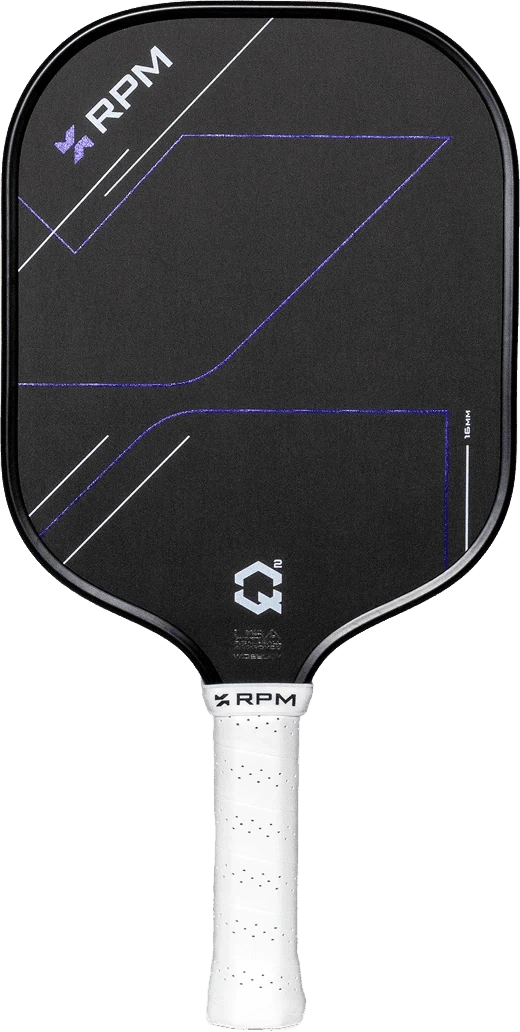
Wide body
16 x 8 in
Swingweight 107.4
Twistweight 6.85
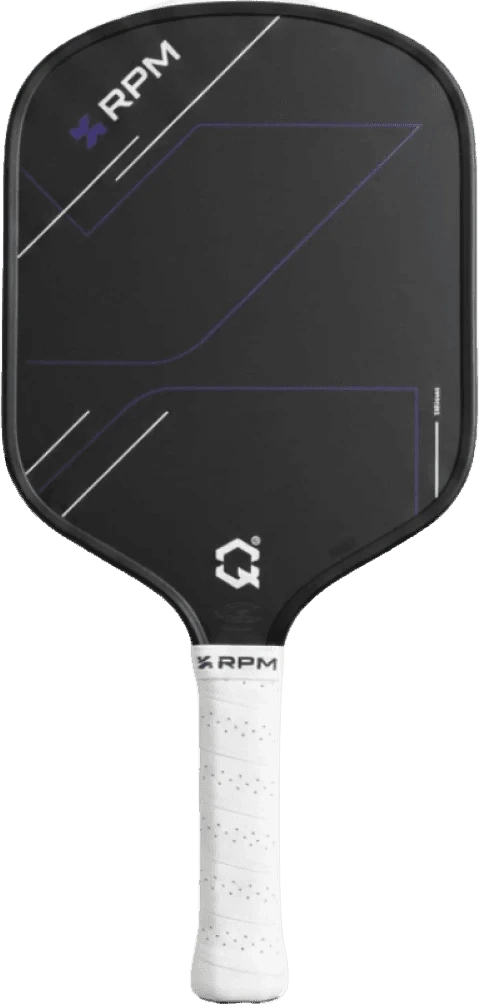
Hybrid
16.3 x 7.7 in
Swingweight 107.7
Twistweight 6.20
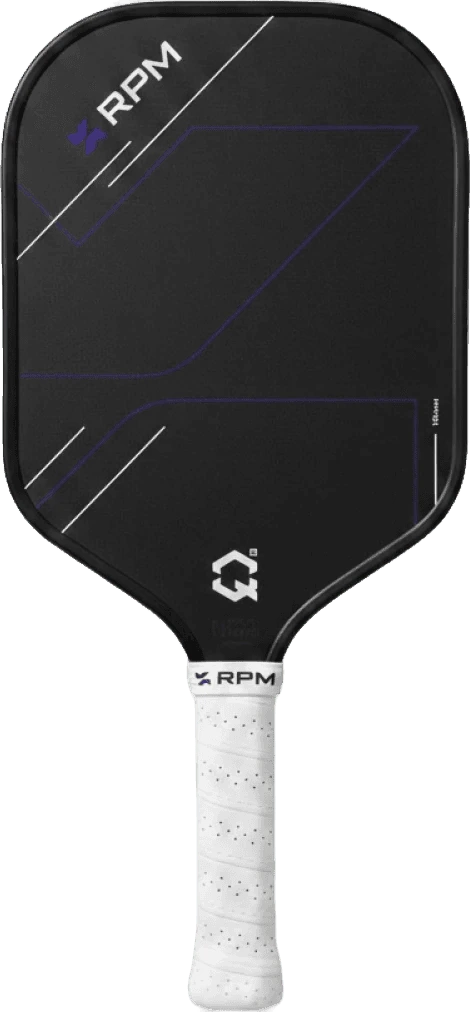
Flat top hybrid
16.3 x 7.7 in
Swingweight 112.0
Twistweight 6.30
Elongated
16.5 x 7.5 in
Swingweight 114.0
Twistweight 5.90
Photos and dimensions from RPM. Swingweight and twistweight measured by Matt's Pickleball.
Wide body to elongated adds 6.6 points of swingweight and takes away almost a full point of twistweight. The curved top hybrid is the odd one: it measured about the same swingweight as the wide body and less twistweight than you'd expect. That's one sample of each paddle, so don't read too much into a small gap. The flat top's numbers are the interesting ones, and I'll come back to them.
The big pattern holds across every line I checked that comes in all three main shapes, including the Six Zero Coral Pro, the Enhance EPP Turbo, the Gherkin Draco and the 11SIX24 Power 2. Going from wide body to elongated adds swingweight and takes away twistweight, every time. The balance point moves toward the tip, too: in John Kew's lab the Coral Pro goes from 23.3 cm on the wide body to 24.1 cm on the elongated.
What doesn't change much is spin. In that same database the median spin for all three shapes lands within about 20 rpm of each other. Spin comes from the face and the core.
Wide body
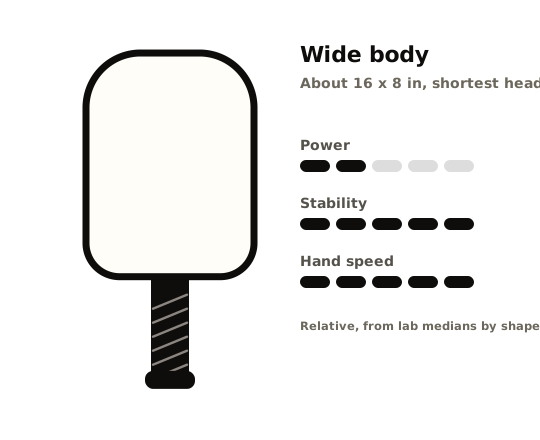
The wide body is the underhanded free throw of pickleball paddles. It's probably the right call for most people, and almost nobody does it, because it doesn't look cool.
There's a stigma on this shape. My guess is maybe 15% of players use one, and it should be closer to 40%.
What it does well: the weight sits closer to your hand. A wide body has the lowest swingweight and the highest twistweight of the three shapes, so you get the fastest hands at the kitchen and the steadiest face on mishits. In the lab medians, a wide body runs about 8 points of swingweight under an elongated paddle and about 0.8 more twistweight.
That combination is also easier on your arm. Weight that lives near your hand puts less load on your elbow every swing, which is why I'd point anyone with tennis elbow here first. Pickleball.com goes further and suggests a wide body with a twistweight of 7.2 or higher for players with arm trouble. And it's no beginner's shape: watch the women's pro draw and you'll see plenty of top players with wide bodies.
So why does nobody buy one? RPM's founder told The Dink that 80 to 85% of the paddles RPM sells are elongated, and that he'd be surprised if anywhere near that many players were actually better off with one. A lot of people buy the shape their friend bought. That's the free throw.
The trade-off: less power on drives and serves, and less reach. You'll feel it most on the ball you have to put away from the baseline.
Who it's for: players who live at the kitchen, players with arm trouble, anyone who wants the most forgiving face in the store, and anyone honest enough to admit they mishit more than they'd like.
Hybrid
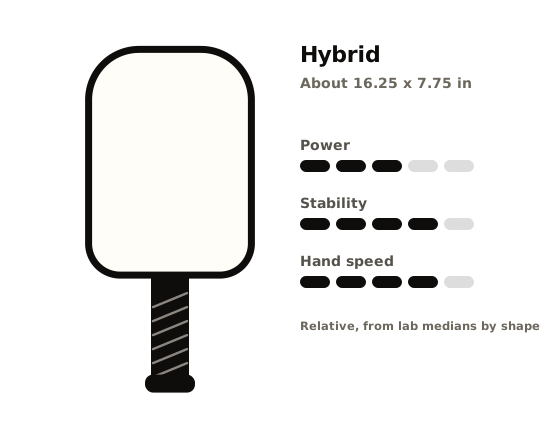
The hybrid is the Goldilocks paddle. Longer than a wide body, wider than an elongated, and in the middle on every number. Six Zero's Coral Pro hybrid measured 111.6 swingweight and 6.76 twistweight in John Kew's lab. That's almost all of the elongated's 112.0 swingweight, and most of the way to the wide body's 7.36 twistweight.
It also still looks like a sports car, which matters more than anybody wants to admit. People who would never be caught with a wide body will happily play a hybrid, and get most of the same stability. That's why I think wide bodies might slowly disappear. The players who should be on one are buying hybrids instead, and honestly, that's fine.
The trade-off: you don't get the most of anything. If you want maximum power or maximum forgiveness, the ends of the spectrum still do it better.
Who it's for: most doubles players. If you don't know which shape you want, start here.
Flat top hybrid
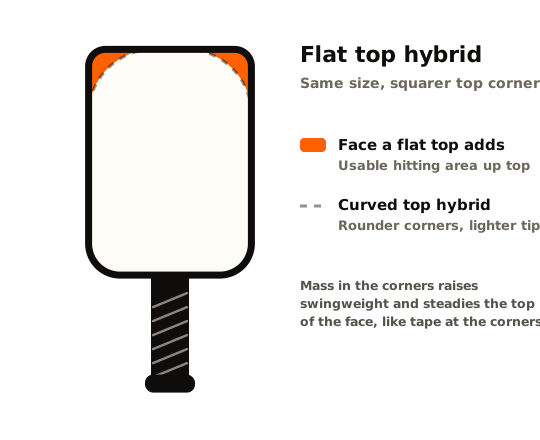
This is the in-vogue shape right now, and it's earned it. A flat top hybrid is a hybrid with the top corners squared off instead of rounded, so the upper part of the face is usable all the way out to the edge.
Squaring off the corners puts a little more mass up top and out wide, which is the same thing tape at the top corners does. RPM lists the Q2's flat top and curved top with identical specs, 110.5 swingweight and 6.5 twistweight. Put them on a rig and they split: Matt's Pickleball measured the flat top at 112.0 swingweight and the curved top at 107.7, with slightly more twistweight on the flat top too. That's one pair of paddles, and I haven't found anyone who's tested more, so treat it as a direction. You get some of the elongated's whip and most of the hybrid's stability, without the narrow face.
That's why I'd play a flat top hybrid over an elongated for most paddles, if the paddle came in one.
Elongated
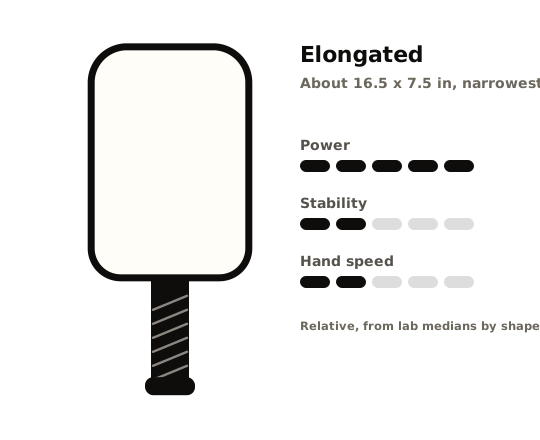
Elongated is the shape I play most, and it's the most popular shape in the lab database by a lot: about half of the paddles in it are elongated.
What it does well: whip. The extra length raises swingweight, and that's power you can feel on drives, serves and put-aways. In the lab medians an elongated paddle runs about 118 swingweight to a wide body's 110.
What it doesn't do: give you reach. Yes, it's half an inch longer. If you're short and shopping for reach, your feet are going to matter far more than half an inch of paddle, and the length changes how the whole paddle swings. It's a power shape that happens to be a little longer. It's not an Inspector Gadget arm.
The trade-off: the narrowest face of the three, so the lowest twistweight and the most twisting on off-center hits. It's also the slowest in a hands battle. Most elongated players fix the stability with tape at 3 and 9, which the weight guide covers.
Who it's for: singles players, players with a tennis background who are used to a longer lever, and anyone who wants to hit hard and will put in the reps to find the sweet spot.
If you hit a two-handed backhand, the number you care about is handle length. Selkirk recommends both its wide body and its elongated for two-handers, because both come with handles near 5.6 inches or longer.
How to tell which shape you're looking at
Most of the time it's printed right on the listing. Wide body, hybrid, elongated. "Standard" usually means wide body.
Some brands give each shape its own name instead, and you have to learn the code. 11SIX24 is the big one: the same paddle comes as the Hurache-X (elongated), the Pegasus (wide body), the Vapor (hybrid) and the Ultré (hybrid). A few more:
| Brand | Elongated | Hybrid | Wide body |
|---|---|---|---|
| 11SIX24 | Hurache-X | Vapor, Ultré | Pegasus |
| JOOLA | Hyperion, Perseus | Kosmos | Scorpeus |
| Ronbus | R1, R3 | R4 | R2 |
| Vatic Pro | Original | Flash | Bloom |
And the labels don't mean the same thing from brand to brand. CRBN's "Square" is 7.85 inches wide, narrower than most wide bodies. CRBN also markets its elongated for "consistency and forgiveness," which is the opposite of what the lab says an elongated face does. Even inside one brand, "elongated" is a family: Selkirk's long shapes run from 7.375 to 7.45 inches wide.
When the listing doesn't say, or you don't trust it, check the dimensions. About 16.5 by 7.5 is elongated. About 16.25 by 7.75 is hybrid. About 16 by 8 is a wide body.
Myths
"Elongated is for reach." Covered above. It's for power.
"Most people play elongated, so it must be right." Most people buy elongated. That's a different stat.
"Wide bodies are for beginners." They're for anyone who wants faster hands and a steadier face, which is everyone. Plenty of pros play them.
"A 116 swingweight is heavy." Depends on the shape. That's heavy for a wide body, about average for a hybrid and light for an elongated. Only compare swingweight and twistweight against paddles of the same shape.
"Shape changes spin." Barely. The lab medians for spin are nearly identical across all three shapes. The outline barely touches it.
"A wider paddle has a bigger sweet spot." Closer to true, but it's really twistweight. A wide body doesn't have more of a magic zone. It just twists less when you miss it, so more of the face feels good.
Which one I'd pick
If you're not sure, start with a hybrid, and get the flat top if the paddle comes in one. If your elbow hurts or you live at the kitchen, play a wide body and ignore what anyone says about how it looks. If you play singles or you want to hit hard and you're willing to put in the reps, play elongated.
The free throw still goes in when you shoot it underhanded.