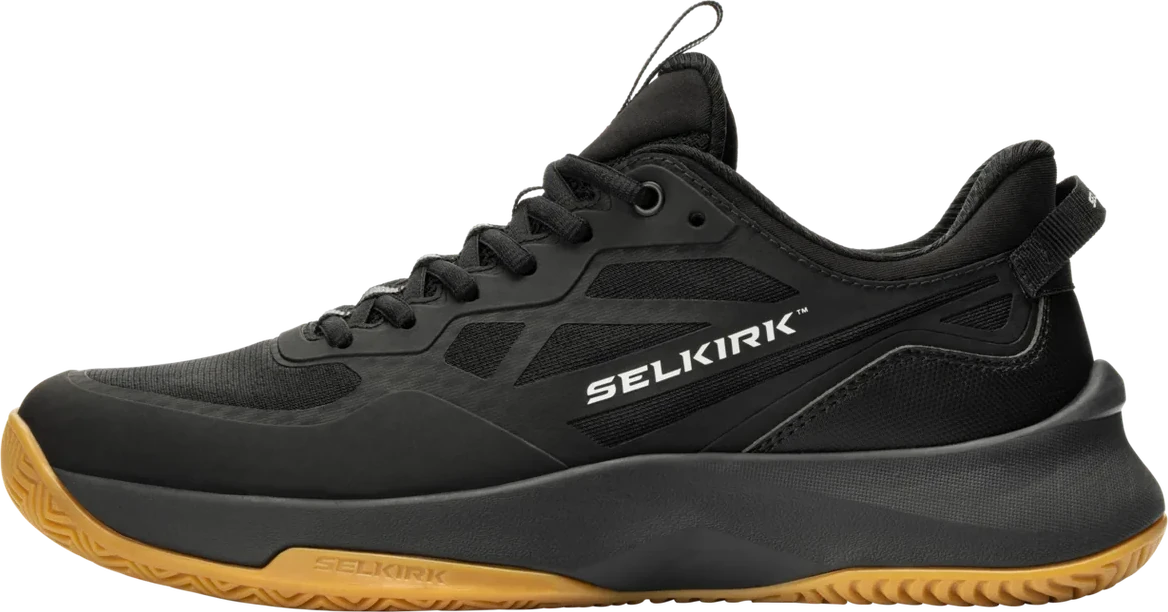
If you asked me which court shoe to buy, I'd say this one. If you watched which shoe I grab on the way out the door, you'd see the Stria G1 Pro. Both of those are compliments, and the rest of this review is about the gap between them.
My bias up front: I'm a 12.5 with a soccer background, no orthotics, and I care how a shoe looks more than a reviewer is supposed to. I've worn every Selkirk CourtStrike Pro there's been, and I've worn the CourtStrike Pro 3.0 more than any other shoe in the last six months. About 80 hours, indoors and out.
Selkirk is a paddle company. I assumed the shoes were a way to sell the same customer one more thing, and I assumed that three times in a row. Three times they shipped a real court shoe. The 3.0 is the best one, and it's the one I'd hand to most people. An elite court shoe from a paddle company. Nobody saw that coming, including me.
The all-around shoe, and the line is one shoe now
Selkirk used to sell two of these: a CourtStrike and a CourtStrike Pro. The 3.0 is just the Pro, and I think that's the right call. Nobody needed two versions of a pickleball shoe. To me there was never a big enough differentiator to justify both.
What you get is a middle ground, and I mean that as the whole point of the shoe. It isn't as stiff as the Pro 2.0. It's a little lighter, a little more breathable, a little more flexible, and it feels faster for all three reasons. The Stria G1 Pro is built for speed and bounce. The SQAIRZ XRZ2 is built for comfort and stability. This sits between them and borrows from both.
Stability is where it earns the Pro on the box. I scored it a 9.2, the highest I've given a court shoe and a full step above the Stria, and the number comes from how little I thought about my feet across 80 hours of being pulled wide.
The dusty-court stop is the test I care about most. I play at an industrial warehouse on a pickleball court, which is not always the most stable surface. In 80 hours I have never slipped in these. I don't move very much, so take that for what it's worth, but I have never slipped, and that's where the grip score comes from.
Halfway through, around hour 40, I swapped the stock insole for a VKTRY Gold insole. The shoe got better, and the insole needed its own break-in before it did. More on those in a separate piece, because at $149 they cost more than the shoe. The point for now: the stock insole got me 40 good hours, and the chassis underneath it was worth upgrading instead of replacing.
The warranty, and how it actually worked
Selkirk backs the outsole for six months. If it wears through to the midsole inside that window, they replace the pair once. Toe bumper and upper aren't covered. That's the whole policy, and every court shoe should have one.
I've used it. My original CourtStrikes broke down after the 2.0 came out, I filed the claim, and Selkirk let me take the replacement as a pair of 2.0s. I don't know if that's standard policy or a nice rep on a good day, so don't buy the shoe expecting the upgrade. Buy it expecting a replacement, which is more than Stria gives you.
One honest caveat: I'm not sure the warranty was written for the people who play every single day. I don't think any shoe is meant to take that kind of punishment, and I don't think Selkirk's lawyers were picturing us when they set six months. But we all do it anyway, and having the option to replace a pair once is the difference between a shoe you trust and a shoe you ration.
They finally look like a shoe you'd pick
I score looks on this site. Here's the three-generation arc: the original CourtStrike Pro was ugly, the 2.0 was okay, and the 3.0 actually looks nice. Black is the one I've been wearing, and it reads as a shoe you chose, which is rarer in this sport than it should be.
The Venn diagram test, same as every shoe review here: would you play a tournament in them, and would you wear them to lunch without changing. The 3.0 passes both. It doesn't pass them the way the Stria does, and I'll get to that below, but it passes.
Where it lets you down
The price. Consolidating the line killed the $100 CourtStrike, so the entry point is $128 now. You're getting the better shoe for the money, and you no longer have a cheaper way in.
The warranty covers one replacement, outsole only, in the US and Canada. If your toe goes before the sole does, which is how a lot of us kill shoes, the policy doesn't help you. Register the pair the day it arrives, because the claim form asks for it.
The stock insole. It was fine for 40 hours and then I wanted more from it, and the fix cost more than the shoe. A $128 shoe that benefits this much from a $149 insole is a shoe with a cheap insole in it.
The toe box. It fit me true to size with nothing pinching, so this one isn't mine. But several players who loved the 2.0 say the 3.0 runs narrower across the forefoot, and Selkirk hasn't said a word about the last changing. If you have a wide forefoot and the 2.0 fit you perfectly, try these on indoors before you commit. The 30-day return window requires them unworn outside.
How it stacks up
These are the decisions I think people are actually making at this price.
- vs. Stria G1 Pro: this is the whole review in one bullet. On my own scores the 3.0 beats the G1 Pro on stability and ties it on grip and cushion. The G1 Pro still scores higher overall here, and the entire gap is the Venn diagram: the way the Stria looks sends it over the edge for me, and I score looks on purpose. What matters most to you might not be what matters most to me. If I were buying shoes for my wife or my kids, I'd get them the Stria. If I were buying for my parents, or recommending one shoe to most people, it's this one. The warranty is the tiebreaker.
- vs. SQAIRZ XRZ2: the SQAIRZ is built for comfort and stability, and it does both. The 3.0 gives up a little of that for a shoe that moves faster and breathes better, and it's cheaper. Pick the SQAIRZ if your feet hurt. Pick the 3.0 if they don't.
- vs. Selkirk CourtStrike Pro 2.0: the 2.0 is stiffer and you can feel it. If you bought the Pro for a stiff chassis, the 3.0 is a softer, lighter, more flexible shoe and you should know that going in. It's also the one that's in stock. The 2.0 is $96 on clearance if your size exists, and for most sizes it doesn't.
- vs. Selkirk Legacy Pro: the Legacy Pro is the one I pack when I refuse to bring two pairs of shoes on a trip. On a court the 3.0 is the better shoe, and it now looks good enough that the Legacy Pro's main argument is thinner than it was.
Who should buy it
Sizing first. The 3.0 fit me true to size, and Selkirk stocks half sizes all the way up to a 14, which more companies should do and most don't. Order your normal size. If your forefoot is wide and you're coming off a 2.0 you loved, try these on indoors before they touch a court.
Buy it if you want one shoe that does everything well, if a six-month outsole warranty is what makes $128 feel safe, or if you're shopping for someone else and want the pick that's hardest to get wrong. Normal-width feet, no orthotics required, dedicated courts indoors or out, any level.
How I tested
About 80 hours over roughly three months, worn more than any other shoe in that stretch. A mix of indoor and outdoor, all on dedicated pickleball courts: hard courts, PickleRoll, and an indoor warehouse court, in rec doubles, competitive doubles, singles, and full tournament days. No gym flooring, so I can't tell you how the outsole behaves on wood. Size 12.5 men's, Black, no orthotics. Stock insole for the first 40 hours, a VKTRY Gold insole after that. I didn't put a shoe on the kitchen scale, so the 13.0 oz in the rail is Selkirk's number for a men's 9. I checked code INF-NICOTHELEFTY on the live cart on Oct 2 2026 before printing it here. It applies, and nothing comes off at checkout. What it earns you is Selkirk's referral credit, $20 in Bonus Bucks on an order between $101 and $200, emailed 7 to 10 business days after the order and good for a year on selkirk.com.
Selkirk sent these shoes and is an affiliate partner. Code INF-NICOTHELEFTY earns you $20 in Selkirk credit on a pair, and they didn't see this review before you did.