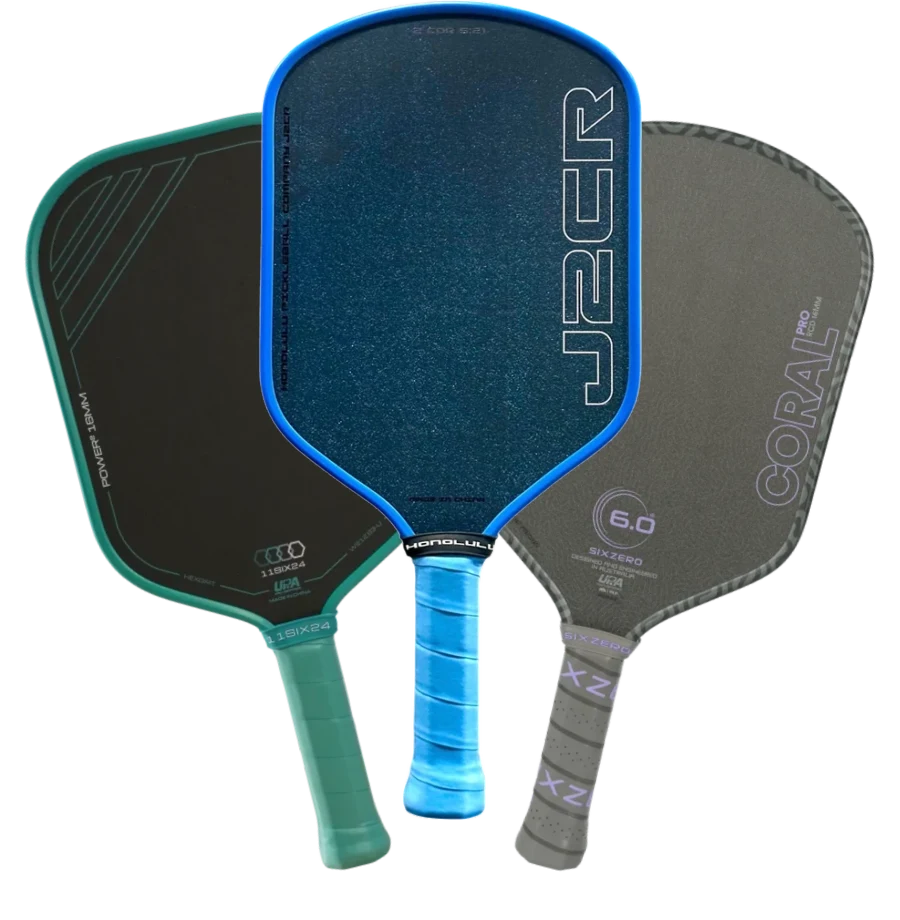
Paddles don't die all at once. The core lasts, the edge guard lasts, the handle lasts. The first thing to go is the spin. One day your roll volley sails long, your topspin serve sits up, and you blame your wrist for a month before you run a thumb across the face and feel glass where sandpaper used to be.
Durable grit is the industry's answer to that. It's also the most over-marketed phrase in pickleball right now, so here's how to tell the real thing from the label.
What durable grit actually is
Most carbon paddles get their texture from peel ply: a sheet of fabric pressed into the epoxy while it cures, then peeled off, leaving the weave pattern behind. That's raw carbon. It grabs the ball great on day one, and then every hit sands it down a little.
Durable grit is any face built to keep its texture longer than that. The trick is putting something harder than epoxy on the surface, or making the epoxy itself tougher.
Up close, you can see it. Here's Bread & Butter's Space Dust Grit on the Loco 2, a Tier 1 face:
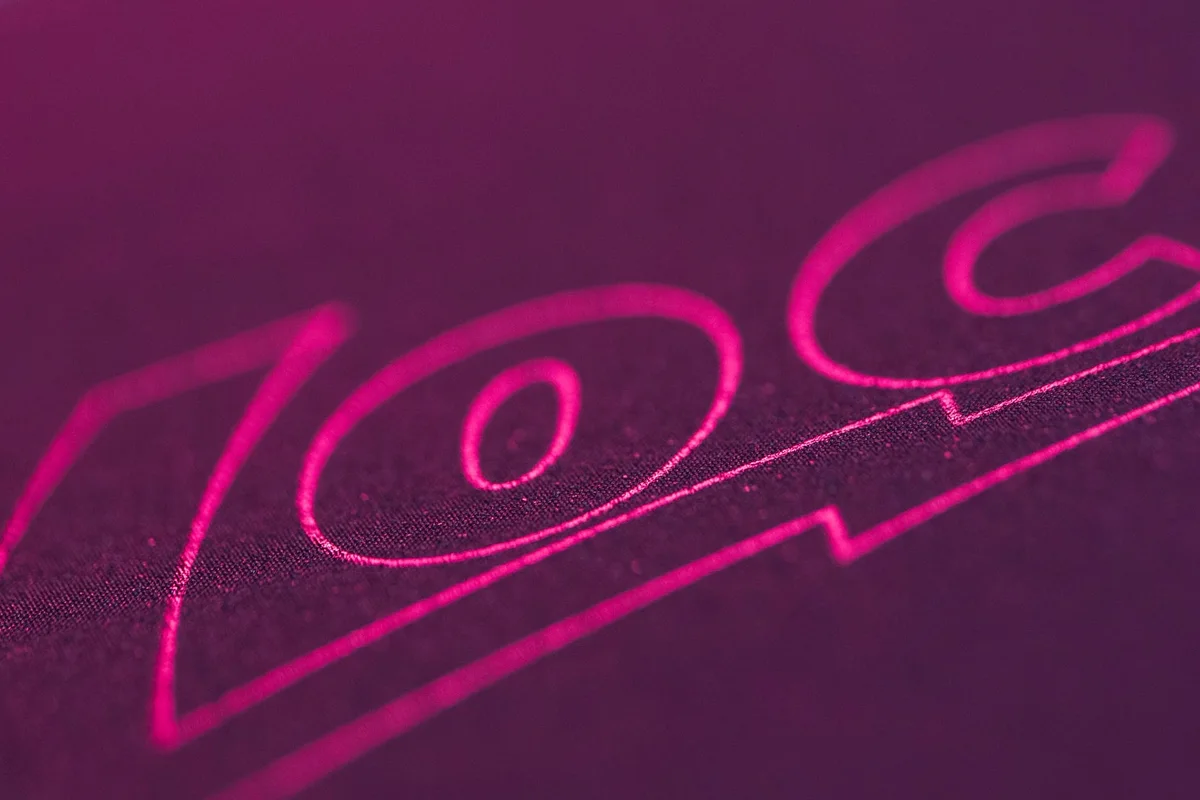
Photo: Bread & Butter
And here's Honolulu's Crystal Blue on the J2CR, also Tier 1. The white flecks are the grit:
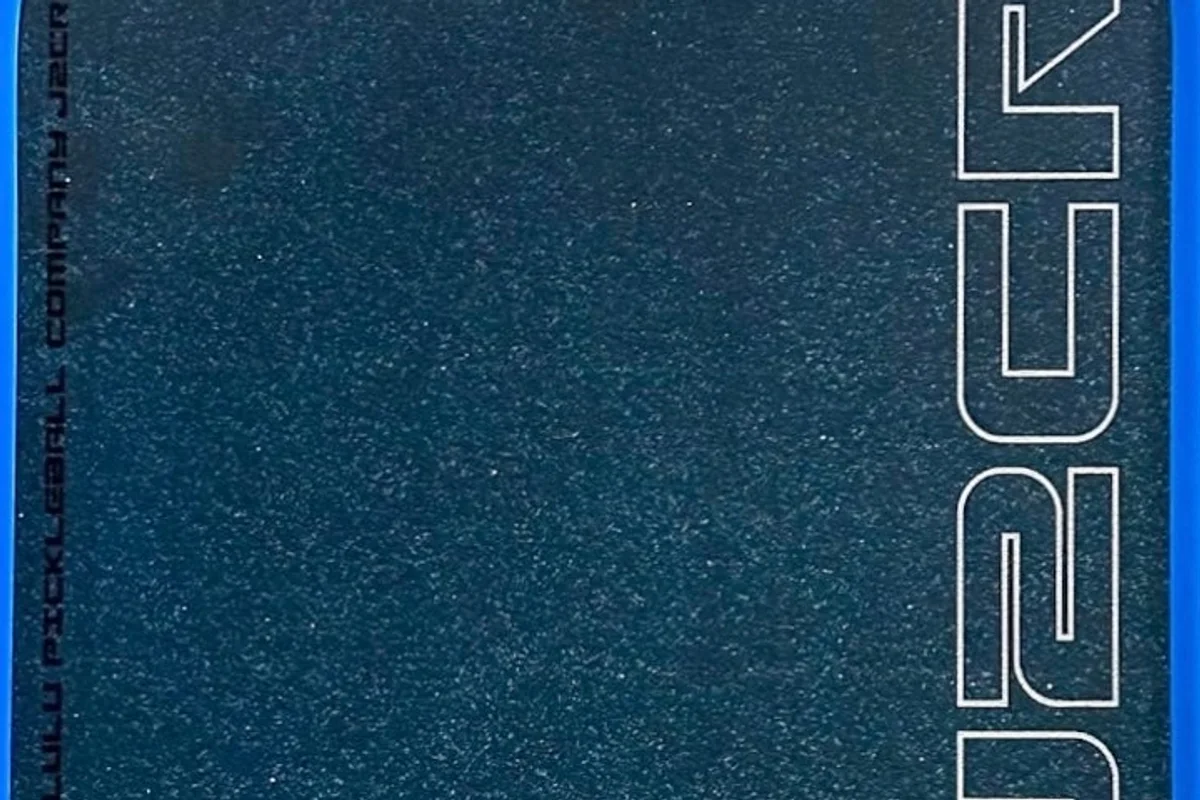
Photo: Honolulu Pickleball Co.
How it's made
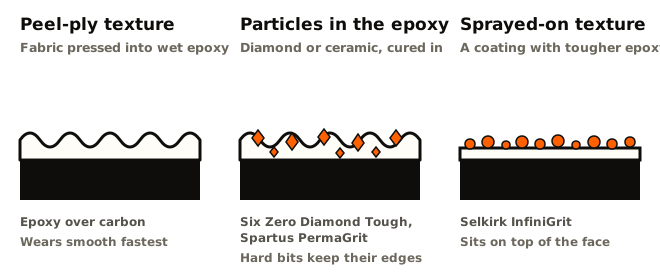
There are three main ways brands do it:
- Peel ply plus particles. Most durable grits are still peel-ply carbon underneath. The upgrade is hard particles mixed into the epoxy before it cures, so the grit is part of the face instead of a coating on it. Six Zero's Diamond Tough uses industrial-grade diamond particles. The Coral Pro's Double Diamond Tough has twice as many, according to Six Zero.
- Mostly particles. Spartus's PermaGrit on the P1 is mostly ceramic particles, with almost no peel-ply pattern left to see. The cheaper PermaGritNano on the Spitfire is a grit-infused peel ply, a different and cheaper build that tests differently (more on that below).
- Spray-on. Selkirk's InfiniGrit is a proprietary sprayed texture with a tougher epoxy.
Then there are the branded names with less public detail: 11SIX24's HexGrit (which Volair licenses for the CMD HYB), Honolulu's Crystal Blue, RPM's SICmatrix, MARK's VelosiGrit, Gearbox's SpinLock, Bread & Butter's Space Dust. Gearbox says SpinLock is built to wear in fresh particles instead of wearing smooth. Every brand has a version of that pitch. The tiers are how you check it.
The tier list most people cite: John Kew's
If you've seen a paddle sold as "Tier 1 grit," the tier almost always comes from John Kew. His list is the closest thing the sport has to an accepted standard, and it's the one I use in my reviews.
The test, from his April 2026 newsletter:
- Room held at 70°F and 50% humidity. New ball for every paddle.
- A high-speed camera, over 2,000 frames per second, reads the ball's spin.
- Spin is measured off a 60 mph shot from a ball cannon.
- The cannon fires 100 shots at 70 mph at the same spot on the face.
- Spin is measured again. The tier is how much it dropped.
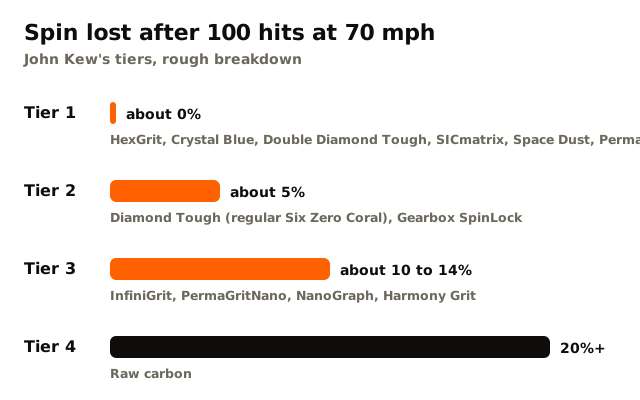
| Tier | Spin lost after 100 hits | What Kew calls it |
|---|---|---|
| 1 | About 0% | Elite spin, zero drop |
| 2 | About 5% | Strong spin, small drop |
| 3 | About 10% | Good spin, moderate drop |
| 4 | About 20% or more | Good initial spin, big drop off |
Some Tier 1 faces come out of the test spinning more. Kew ran 200 hits on a Jelly Bean 2 and it went from 2,350 to 2,430 RPM. A raw carbon control paddle lost 33% over the same test, two thirds of that in the first 50 hits. That's the whole argument for durable grit in one sentence: raw carbon's best day is the day you open the box.
Kew calls his tiers a rough breakdown, and he's right to. It's one tester, one rig, a handful of units per paddle. It's still the most consistent grit data anyone publishes, which is why everybody quotes it.
The paddles in each tier
Every tier below comes from Kew's database, checked October 27, 2026. Linked paddles are ones I've reviewed; the rest are the popular paddles Kew has tested that I haven't. Hours are mine, on my units.
One thing first, because the names are close: the Coral Pro and the Coral are two different faces. The Coral Pro's Double Diamond Tough is Tier 1. The regular Coral's original Diamond Tough is Tier 2.
Tier 1: zero drop
- 11SIX24 HexGrit: the Power 2 Ultré and the Jelly Bean 2, plus every other Gen 2 Power 2 and Jelly Bean 2 (Hurache-X, Pegasus, Vapor). The most-tested surface on the market.
- Volair CMD HYB 16mm: licensed HexGrit.
- Honolulu Crystal Blue: the J2CR (7 hours), J6CR and J3CR. Only the Crystal Blue versions; Honolulu's raw carbon J6CR is Tier 4.
- Six Zero Coral Pro: Double Diamond Tough, all three shapes. Zero spin lost; it actually went up 0.7%.
- RPM Jade: SICmatrix. Every other RPM paddle in Kew's database is Tier 4.
- Bread & Butter Loco 2: Space Dust Grit, Hybrid and Elongated. The original Loco was Tier 4. After 11 hours mine still bites like day one.
- Spartus P1: PermaGrit, the full bonded-particle version.
- Luzz Cannon XPP, Owl CXE and Proton Series One Type A.
Tier 2: small drop
- Six Zero Coral (the regular one, not the Pro): original Diamond Tough, all three shapes.
- Gearbox Pressure X 8E and 8M: SpinLock.
- Luzz Pro 4 Inferno 2.
Tier 2 is a short list because most faces either hold or they don't. Of the 489 paddle entries in Kew's database, six are Tier 2.
Tier 3: moderate drop
- Spartus Spitfire: PermaGritNano, about 14% spin lost across two units. A real step up from raw carbon, not elite. After 15 hours I still can't feel or measure a drop.
- Aireo Cyclone: NanoGraph.
- Selkirk InfiniGrit: the LABS Project Boomstik, OMNI, LABS 007 Invikta and Luxx II Control Air Invikta.
- Vatic Pro V-Sol Tour (Bloom, Elongated and Flash), JOOLA Power FX, Thrive Ignite Pro, Chorus CODA Harmony Grit, Ronbus Tenon, Wika QD Fire 2 and Six Zero Boulder Opal.
Tier 4: big drop
- Raw carbon, which is most of the market. The Speedup Tide 14H is my example: it plays great, and the face is going to smooth out.
Unproven
- MARK unMARKed 2026: VelosiGrit. Kew's sheet lists it at Tier 4, the same grade as raw carbon, but Pickleball Effect's abrasion test rates VelosiGrit top tier. Until those line up, I'm calling it unproven.
Other testers measure grit differently
Kew measures spin, but that's not the only way to judge a face. Other reviewers measure the surface itself, and they don't always agree with him.
Pickleball Effect uses a profilometer, a needle that traces the face and reads how rough it is, before and after an abrasion machine wears it down. They track two numbers and run their own four-tier scale based on how much texture survives.
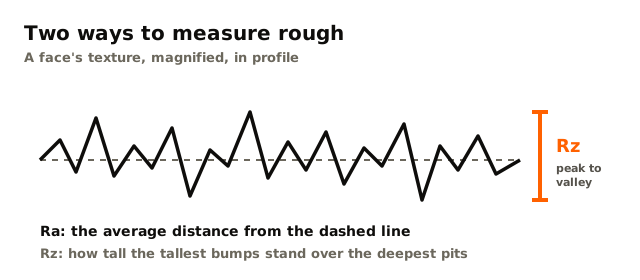
- Ra is the average roughness, how far the texture sits from its middle line on average.
- Rz is peak to valley, how tall the tallest bumps stand over the deepest pits.
Matt's Pickleball measures surface depth, and reported the Coral Hybrid losing 3.4% of it after wear.
Chris Olson skips the machine entirely and tracks real paddles in real games. He followed a HexGrit face across 500 games and watched spin go from 2,122 to 2,117 RPM.
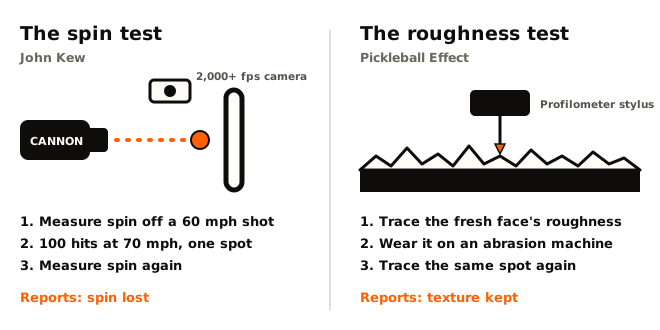
These testers answer different questions, so they can land on different answers. The Spitfire is the clearest case. Kew's impact test put PermaGritNano in Tier 3. Pickleball Effect's abrasion test rated the same surface top tier, and that's the result Spartus quotes on its product page. Notice which test made the marketing. The MARK is the same story in reverse, and the two also split on the regular Coral's Diamond Tough and on Harmony Grit.
Neither tester is wrong. A face can lose a little texture and keep its spin, or keep its texture and lose some grab. When two methods agree, as they do on HexGrit, Crystal Blue and PermaGrit, you can trust it. When they split, the truth is probably in between.
A ball cannon is not a game
Here's the part the tier labels leave out. Every one of these lab tests is a ball fired out of a cannon, at the same spot, at the same speed, in a room held at 70 degrees. A hundred identical shots tell you how a face handles a hundred identical shots.
Your paddle's life looks nothing like that. The cannon doesn't play on a dusty outdoor court. It doesn't hit a wet ball, a cracked ball, or a ball that's been rolling through the dirt by the fence for three games. It doesn't brush up on a roll volley, carve a slice, or catch a ball off the edge of the sweet spot. It doesn't sit in a hot car between sessions.
The testers say this themselves. Pickleball Effect says its test doesn't simulate a set number of hours and doesn't predict how long a paddle lasts. It only compares paddles under the same wear. Kew says a zero-loss result doesn't mean a face keeps its grit forever, because spin on every paddle fades eventually. He's working with Chris Olson on real-world tracking for exactly that reason.
So read the tier as a ranking, not a timeline. Tier 1 grit should outlast Tier 3 grit. Nobody can tell you that means a year, or two seasons, or 300 hours. Look at the full range of reviews before you buy: Kew's tier, the roughness tests, players who've tracked the paddle over months, and what reviewers felt on court. One number from one machine is a starting point. When every source points the same way, that's a paddle you can count on.
Why it matters
It's a value question. A $250 paddle that goes smooth in three months costs you more per month than a $180 paddle that holds its bite for a year. The Spitfire at $109.99 out-spins paddles twice its price on Kew's rig. The question is how long it keeps doing that.
The rules just changed. Since October 1, 2026, USA Pickleball approves paddles with a Spin Rate Test that measures the ball's actual spin off the face, with a 2,100 RPM cap. That matches the cap UPA-A has enforced since 2024. The old test used surface roughness as a stand-in for spin. The new one isn't retroactive: paddles approved before October keep the standard they were approved under. Pickleball Effect has a good breakdown. Different rigs read different numbers, so don't hold a reviewer's RPM up against the 2,100 cap.
Check which list your paddle is on. A lot of the best grit is legal in only one system. Kew's database lists every Tier 1 HexGrit, Crystal Blue and Coral Pro paddle as UPA-A approved only, though Six Zero now sells a Coral Pro Hybrid marked as approved by both, so check the exact version you're buying. The RPM Jade and Spartus P1 are USAP approved. The Loco 2 is approved by both, which makes it rare. If you play USAP-sanctioned events, check the approved list before you buy, not before your first match.
Ignore the multipliers. "Lasts up to four times longer than raw carbon" is a line you'll see in marketing copy, and nobody has published the test behind it. Tiers come from testers. Multipliers come from ad copy.
What I'd buy
If spin is your game and you play a lot, buy Tier 1 and stop thinking about it. Here's where I'd look:
- HexGrit: the Power 2 Ultré or the Volair CMD HYB. Same face, the most-tested grit in the sport.
- Crystal Blue: the Honolulu J2CR or J6CR. The best-looking grit in pickleball, and it holds.
- Double Diamond Tough: the Six Zero Coral Pro.
- For USAP events: the RPM Jade or the Bread & Butter Loco 2, both Tier 1 and both legal where the UPA-A-only paddles aren't.
Want to see two of them side by side? Compare any two paddles.
Your paddle's grit is going to fade. The tier tells you how fast.
Sources and method: spin tiers come from John Kew's paddle database, checked October 27, 2026, and his durable grit test. Roughness testing is described from Pickleball Effect's methodology. Surface depth figure from Matt's Pickleball, as reported by the PPA Tour. Close-up photos from Bread & Butter and Honolulu Pickleball Co. Hours are my own, on my units. Rules checked October 27, 2026.