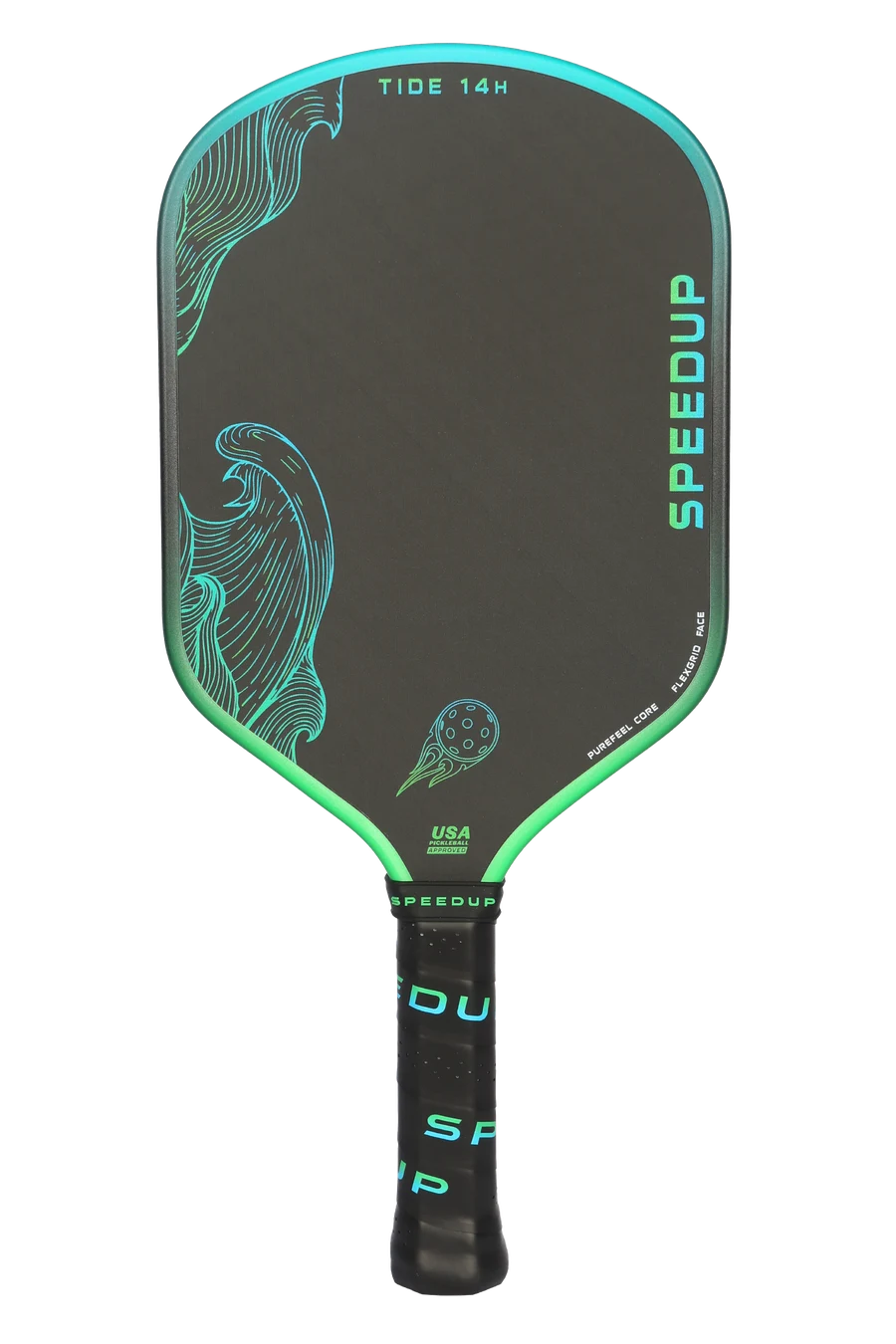
I don't like 14mm paddles. Never have. The ball leaves the face before I've decided what I want to do with it, so I spend the whole session playing catch-up. When the Speedup Tide showed up in a 14mm hybrid, it sat in my bag for three weeks because of the number on the box.
Thirteen hours later I can't put it down, and a couple of paddles I genuinely like are collecting dust because of it. Take the rest of this review with that in mind: the Tide converted someone who wanted to dislike it.
You can shape the ball with it
I felt it on my first few drives. The ball stayed on the face a beat longer than any 14mm I've played, and in that beat you can add shape and spin you'd normally need a thicker paddle to find. Once I started looking for it, the same dwell showed up on resets, then on dinks at the kitchen.
Under the hood it's a gen 4 foam core like most of the fast paddles right now, but Speedup tuned theirs to hold the ball instead of ejecting it — the core, the ring around it, and the flexy face all point the same direction. That's why my 14mm rule broke. The rule was written in the honeycomb era, when thickness told you how a paddle would feel, and this 14 plays softer than the number.
None of that costs you the pop. At a claimed 112 swingweight in a 14mm core, drives come off hotter than the effort you put in, and in hands battles it moves like something a size smaller. Fast paddles are common, though. What sold me is getting that speed without giving up the drop.
It helps to know who built it. Speedup's founder, Santhosh Narayanan, is an elite 6.0 who plays pro, and a guy who has to reset in pro firefights was never going to ship a paddle he couldn't reset with. The design decisions read like someone building for his own game.
Where it lets you down
It takes a few games to learn. Because the ball stays on the face, you have to hit through it with more follow-through than you think. I was used to foam paddles that eject the ball the instant it arrives, and I spent my first couple of games putting balls into the top of the tape while I recalibrated. Not long, not wide. Tape. Budget two games for the adjustment and don't debut it in a match that matters.
I don't trust the grit to last. The face feels like the kind that gives you an incredible first month and then quietly becomes a different paddle. Since spin is one of the main reasons to buy the Tide, that question matters more here than it would on a power-first paddle. If the surface goes the way I suspect, this review gets updated, including if it's bad.
How it stacks up
- vs. Aireo Cyclone (16mm hybrid) — someone told me the Tide was "a better Cyclone," and I'd say it's a different paddle instead. Both are foam cores, but they're tuned for opposite things: the Cyclone's PulseFoam build is extreme pop and extreme power in something extremely light, and it makes no apology for that. The Tide gives you similar pop with more feel, despite running the thinner core. Pure power, take the Cyclone. If you want to keep your soft game, take the Tide and save $46.
- vs. RPM Friction Pro (16mm) — the closest comp I've got. The Tide honestly plays like a 16mm Friction Pro that got faster in my hands. The Friction Pro runs $249.99, and the Tide is $153 with code NICOTHELEFTY, so you're saving about $97 on a very similar feel.
- vs. Spartus Spitfire — I played the Spitfire the same day, right after the Tide, and the Tide made a genuinely fantastic paddle feel like a boat anchor. No knock on the Spitfire, which is excellent and getting its own review next. Play these two back to back and you'll understand within four minutes what the 14mm core and hybrid shape do to your sense of weight.
The price is doing a lot of work here
It's $169.99, and $153 with code NICOTHELEFTY. I want to be careful with the phrase "value paddle," because it usually means "good for the money," and the compliment doubles as a ceiling.
The Tide performs with the flagships from the biggest brands in the category, the ones asking $200 to $250, at a hundred dollars under most of them. Somebody is going to spend $250 this month on a paddle this thing hangs with.
Who should buy it
The 4.0-and-up player, specifically. Anyone can play the Tide and have a good time, but what you're paying for is the stuff you have to be good enough to notice — the shape you can put on a drive, the extra beat on a reset. Below 4.0 you're buying headroom you haven't grown into yet.
Past that, it's for the player who wants power without becoming a bang-only player, and for anyone who wrote off 14mm the way I had. At $153 this is the cheapest way I know to test that belief.
Skip it if you want a paddle that plays right out of the wrapper with no adjustment, or if you need the face to still be biting a year from now. On the second one, I don't know yet, and I'll say so here if that changes.
How I tested
Thirteen hours across four sessions, all rec doubles. No singles and no competitive play yet. When I get those reps, this review gets updated.
I don't own a bench rig, so the weight and balance numbers in the rail are Speedup's published specs, labeled as theirs. The spin number is different, because Speedup doesn't publish one. It's the average of two independent lab tests: John Kew measured the 14H at 2,269 RPM and Matt's Pickleball measured 2,259, and two labs landing within ten RPM of each other is about as solid as third-party data gets. On their scales that's above-average spin, not elite. In my hands the grab off this face played better than that number suggests, and I'd bet the dwell is why — you have longer to brush the ball, so the same RPM does more.
Speedup sent this review unit and is an affiliate partner — code NICOTHELEFTY earns me a commission while saving you the $17. They didn't see this review before you did, and the paddle sitting unused in my bag for three weeks should tell you how much that relationship influences my schedule.